Why Your Hands and Feet Slip on a Hot Board in Late Summer
Quick Answer: EVA deck pads soften as they heat, which changes how the texture engages with skin, and a hot deck also makes you sweat onto it. Sweat is a thin, low-viscosity film that behaves very differently from lake water, and it defeats the grooves that normally channel water away. The result is that a board which felt secure in June feels slick in late August, at the same paddling ability.
The board changed, not your balance.

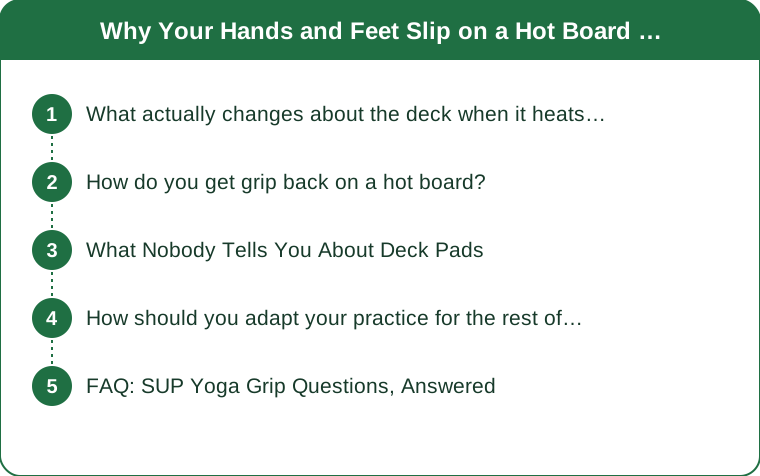
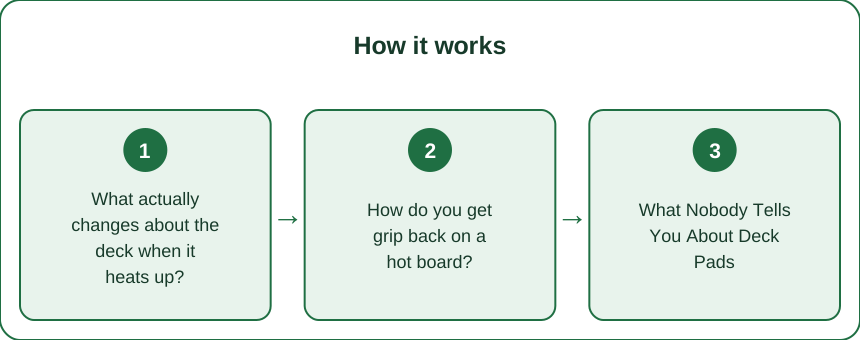
What actually changes about the deck when it heats up?
The material softens, the surface film changes, and the two combine.
Most deck pads are EVA foam with a diamond or crosshatch groove pattern. Grip comes from two things working together: the friction of the foam surface, and the grooves, which give water somewhere to go so that skin contacts foam rather than floating on a film.
Heat affects both.
EVA softens as its temperature rises. A dark deck pad in direct late summer sun readily reaches temperatures well above air temperature, and softened foam deforms more under load. The groove edges round off under pressure rather than biting, which reduces the mechanical part of the grip.
Sweat is the bigger problem. Lake or sea water is what deck pads are designed around, and grooves channel it efficiently. Sweat arrives continuously, in small amounts, spread thinly across the whole contact area, which is exactly the condition grooves handle worst. A thin continuous film is more slippery than a larger volume of water that can drain.
Sunscreen and oils compound it. Whatever is on your hands and feet transfers to the pad and stays there, and over a season it accumulates into a genuinely slick residue.
Your feet swell in heat too. Vasodilation increases foot volume slightly, which changes how your weight distributes across the sole and how much of the surface is actually in contact.
So the slipping is real and it is environmental. It is not a sudden loss of technique.
How do you get grip back on a hot board?
Temperature management, surface management, and a small change to how you place your hands and feet.
Rinse the deck before you start, and again mid-session. A quick splash of water across the pad cools it and removes accumulated residue. This is the single most effective thing on the list, and it takes five seconds.
Wash the pad properly at the end of the season, or sooner. Mild soap, soft brush, thorough rinse. Sunscreen residue builds invisibly and is the reason a two-year-old board grips worse than a new one, more than wear.
Paddle out early. A board in the water at 7am has a deck pad at water temperature rather than sun temperature, and the difference in grip is obvious immediately.
Keep the board out of the sun on shore. Deck down, or in the shade, or under a cover. Twenty minutes on hot sand is enough to change how it behaves.
Change how you place your hands. Press rather than slide. Place the hand where you want it and load it downward, instead of setting it lightly and adjusting position by sliding, which is what generates the slip.
Spread your fingers and toes. More contact area, more edges engaged with the groove pattern.
Dry your hands on your suit before a transition. A two second wipe before a hand placement is worth more than any product.
Consider grip aids carefully. Chalk does not work on a wet board. Some paddlers use grip-specific sprays, and anything that leaves residue makes the long-term problem worse.
And place poses on the pad rather than on the rails, since the grooved area is where the grip design actually lives.

What Nobody Tells You About Deck Pads
Dark deck pads run considerably hotter than light ones, for the same reason dark cars do. If you have any choice at purchase, colour is a genuine functional decision in hot climates rather than an aesthetic one.
Groove depth matters more than texture roughness. A pad with shallow, decorative grooves looks textured and drains poorly. Deep grooves keep working when there is water on the surface, which is the entire point of them.
Sunscreen is the enemy of deck grip. It is unavoidable and it is the single largest cause of grip degrading over a season. Apply it before you get on, let it absorb, and rinse the pad regularly.
A softened hot pad also feels more comfortable, which is why people do not connect the comfort with the slipping. The same softening does both.
Board pressure changes grip indirectly. Heat raises the pressure in an inflatable, which makes it stiffer, which changes how much the deck flexes under your foot and how the pad engages. Check pressure in the shade, not after an hour in the sun.
Feet slip differently from hands. Feet fail on the outside edge as the ankle rolls; hands fail forward as the wrist loads. The corrections are different — feet need a wider stance, hands need pressure into the heel of the palm.
The last hour of daylight is the best grip of the day, because the pad has started to cool while the water is still warm.
How should you adapt your practice for the rest of the season?
Late August is a good window on the water, and it needs a different plan than June did.
Sequence around the temperature. Do the transitions and balance-demanding poses early in the session, while the pad is coolest and cleanest. Save long holds and floor-based work for later, when grip matters less because you are not moving between hand positions.
Widen your base by default. A slightly wider stance costs almost nothing and buys a large margin when the surface is less predictable.
Anchor if there is any breeze. Late summer afternoons often bring a reliable onshore breeze, and drift plus a slick pad is a worse combination than either alone.
Expect water temperature to stay high while air cools. Through late August the water holds its heat while mornings begin to cool, which means the air can feel fresh while the water remains comfortable. This is the best part of the season for early sessions, and it is short.
Reapply sunscreen off the board. Step onto shore or sit on the tail rather than applying while kneeling in the middle of the pad, and let it absorb before you go back to hands.
Watch daylight. Evening sessions that worked in July are now running into dusk, and getting caught on the water in fading light is a genuine safety issue rather than an inconvenience.
End of season is the time to service the board. Deep clean the pad, check the fin box, inspect the leash, and store it out of sunlight. UV degrades PVC and EVA more than water does, and a board stored in a hot garage ages faster than one that spent the summer in a lake.
As always, wear a leash, know the water you are on, and take conditions seriously. Warm water in late summer can still bring rapid weather changes.
FAQ: SUP Yoga Grip Questions, Answered
Why do I slip more now than earlier in the summer?
A hot deck pad softens and you sweat onto it, creating a thin film that grooves are poor at clearing. Accumulated sunscreen residue from a whole season adds to it.
Does rinsing the board really help?
Yes, noticeably. It cools the pad and removes residue and salt, and it takes seconds. Do it before you start and again if the session runs long.
Should I clean my deck pad, and how?
Mild soap, a soft brush, and a thorough rinse. Do it monthly in heavy season use, and again before storage. Avoid solvents, which damage EVA.
Is a wet board more slippery than a dry one?
Not necessarily. A properly grooved pad handles clear water well. A thin sweat or sunscreen film is worse than a splash of lake water, which is counterintuitive and consistent with how the grooves are designed to work.
TL;DR:
- Deck pads soften in heat, which reduces how sharply the grooves bite under load.
- Sweat forms a thin film that drains far worse than lake water, and sunscreen residue accumulates all season.
- Rinse the pad before and during, keep the board out of the sun on shore, and press rather than slide when placing hands.
- Late summer mornings, with cool air and warm water, are the best grip conditions of the year.
Rinse your deck before the next session and see how different the first transition feels.
See It in Motion
Seen here: High Waist Bootcut Yoga Pants with Hidden Pocket — shop it on bubblelime.com
Keep Reading
This article is for general informational and styling purposes only. Fit, sizing, and product availability may vary.