Why Cooler Water Changes How You Should Plan a SUP Yoga Session
Quick Answer: Cooler water changes three things at once: falling in has a real physiological cost, your muscles take longer to reach working temperature, and cold hands lose the fine grip that balance depends on. Plan for a longer warm-up on land, a shorter session on the water, and a sequence that front-loads the harder poses while you are warmest.
The same board. The same lake. The same flow you have practised since June.
And suddenly you are falling in transitions that were comfortable a month ago.
The water changed before the weather did.
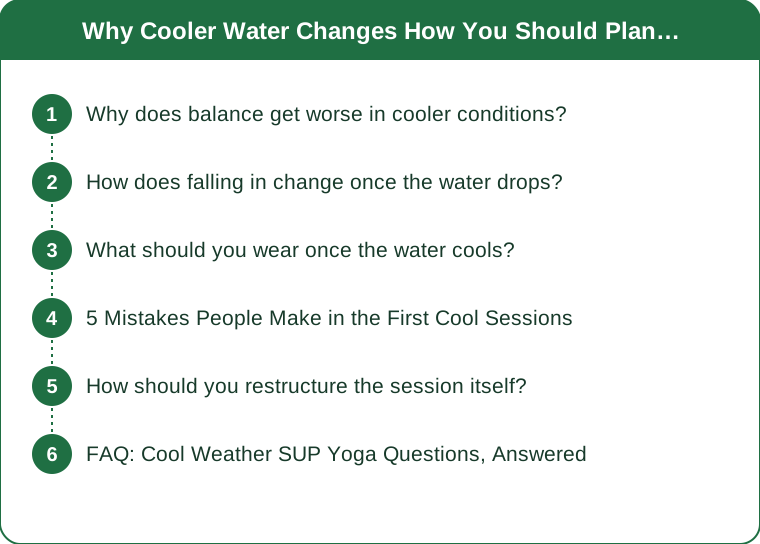
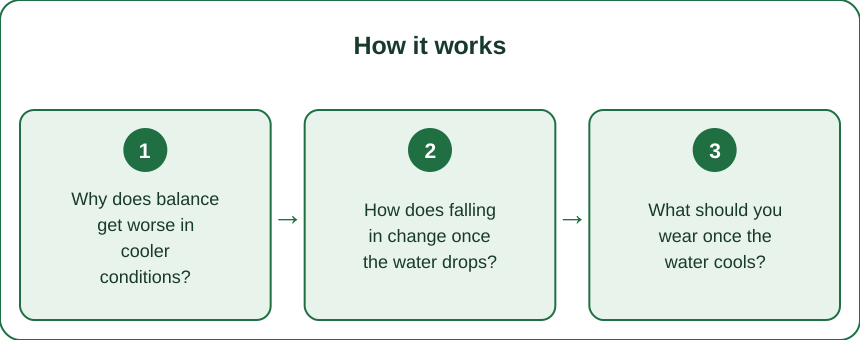
Why does balance get worse in cooler conditions?
Because balance is a sensory task before it is a strength task, and cold degrades the sensing.
Standing on a board requires constant micro-corrections driven by feedback from your feet, ankles and hands. Cold reduces the sensitivity of skin receptors and slows nerve conduction slightly, so the information arriving is both less detailed and marginally later. You compensate with bigger, later corrections, which is exactly what tips a board.
Cold also increases muscle stiffness. A cold calf and ankle complex is less able to make the small, fast adjustments that keep you over the centre of the board, so you rely more on hip and arm movements, which move your mass around and destabilise you further.
None of this is dramatic at 18 degrees. It becomes noticeable somewhere around 15 degrees and below, and it is the reason the first genuinely cool session of the season always feels like a step backwards.
How does falling in change once the water drops?
It stops being a non-event, and this is the part that deserves real respect.
In summer, falling off is a refreshing interruption. Below roughly 15 degrees, an unexpected immersion triggers the cold shock response — an involuntary gasp, a sharp rise in heart rate and breathing rate, and a period of two to three minutes where breathing control is genuinely difficult. It is the most dangerous phase of cold water immersion, and it happens well before hypothermia is a factor.
The practical implications are straightforward and worth following without much debate:
Always wear a buoyancy aid or a leash appropriate to your water, and know which is right for your environment.
Do not practise alone in cooler water, and stay closer to shore than you would in summer.
Assume you will get wet and dress for the water rather than the air.
This is general safety information rather than a substitute for local instruction. Conditions on tidal or moving water differ substantially from a sheltered lake.
What should you wear once the water cools?
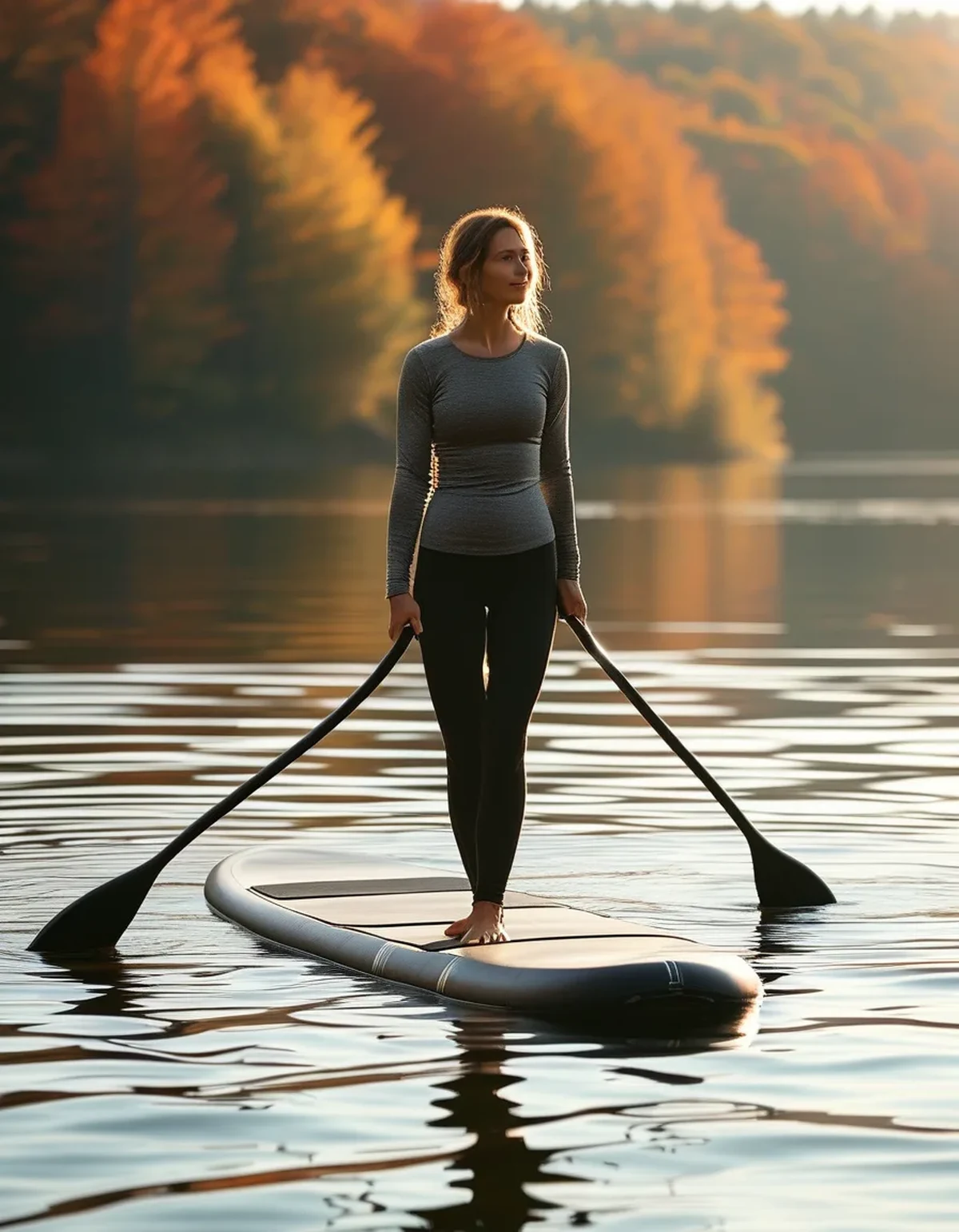
Layer for the water temperature, not the air temperature, and accept that you will be slightly warm on land.
A reasonable progression as the season turns:
Water above 18 degrees: normal kit, plus a long-sleeve rash top for wind chill on the paddle out.
Water 15 to 18 degrees: a neoprene top or shorty, or a thermal base layer under a windproof. Neoprene booties make a genuine difference to balance, because cold feet lose sensation quickly and your feet are your primary sensor.
Water below 15 degrees: a full wetsuit or drysuit, gloves, and a much shorter session. At this point SUP yoga becomes a specialist activity rather than a casual one.
One detail that matters more than it should: hands. Cold hands lose grip strength and fine control, which affects every transition where you place a palm on the board. Thin neoprene gloves preserve enough dexterity for most flows and are worth carrying from September onward.
5 Mistakes People Make in the First Cool Sessions
1. Keeping the summer warm-up. A five-minute land warm-up that was plenty in July is not enough in September. Give it ten to twelve minutes, on shore, with movement rather than static stretching, so you arrive at the board already warm.
2. Sequencing the same way. Summer flows often build toward the hardest balance work at the end. In cool conditions you are getting colder as the session goes on, so the hardest poses belong in the first third.
3. Staying out just as long. Cut total on-water time by a third for the first few cool sessions. You are not losing fitness; you are avoiding the point where cold degrades your judgement as well as your balance.
4. Ignoring the wind. Wind chill on wet skin is the dominant factor in how cold you actually get, and a light breeze that was pleasant in August is a real problem in September. Check wind before water temperature.
5. Leaving the dry layer in the car. The most avoidable mistake of the lot. Bring a dry base layer and a warm top to the water’s edge, not to the car park, so it is available the moment you come off the board.
How should you restructure the session itself?
Think of it as three shorter phases rather than one continuous flow.
Phase one, on land, ten minutes. Dynamic movement to raise body temperature — leg swings, hip circles, cat cow, a few sun salutations. The goal is to be genuinely warm before you get on the water, because you will not get warmer once you are out there.
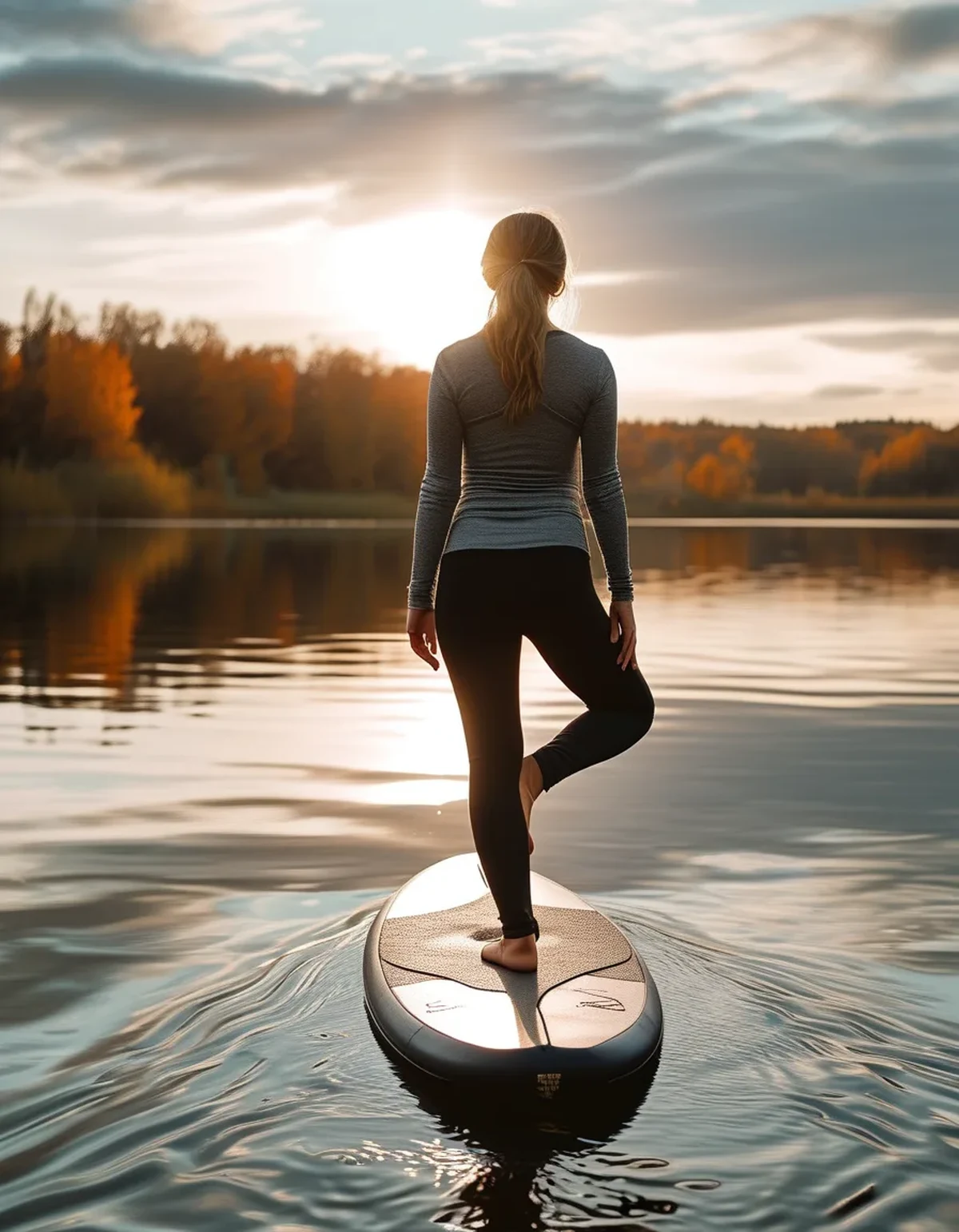
Phase two, on the water, the hard part first. Paddle out briskly enough to maintain heat, then work through your balance-demanding poses while you are at your warmest and most coordinated. This is a reversal of the usual structure and it is the single most useful change.
Phase three, wind down while moving. Rather than finishing with a long stillness on the board, which cools you rapidly, finish with a steady paddle back. Save savasana for the shore, wrapped in the layer you brought down with you.
As the season progresses further, most practitioners naturally shift toward paddling with a short flow rather than a full class on the water, and eventually move the practice indoors until spring. That is a sensible progression rather than a defeat.
FAQ: Cool Weather SUP Yoga Questions, Answered
What water temperature is too cold for SUP yoga?
There is no single number, but below roughly 15 degrees the risk profile changes enough that a wetsuit, a buddy and a shorter session should be non-negotiable. Below 10 degrees, most people should move the practice ashore.
Does an inflatable board behave differently in cold?
Yes — air pressure inside the board drops as temperature falls, so a board inflated in a warm car and used on cold water will be softer than expected. Check and top up pressure at the water’s edge.
Should I still practise barefoot?
On cool water, neoprene booties are worth the small loss of direct feel. Cold feet lose sensation quickly, and numb feet cost you far more balance than a thin sole does.
TL;DR:
- Cold degrades the sensory feedback balance depends on, which is why the first cool session feels like a regression.
- Below about 15 degrees, falling in triggers cold shock — wear a buoyancy aid, never practise alone, and dress for the water.
- Front-load the hard poses, warm up longer on land, and cut on-water time by a third.
- Bring the dry layer to the water’s edge and finish with a paddle rather than a long stillness.
The practice does not have to end when the water cools. It just has to be planned in a different order.
See It in Motion
Seen here: High Waist Yoga Leggings with Side Pockets — shop it on bubblelime.com
Keep Reading
This article is for general informational and styling purposes only. Fit, sizing, and product availability may vary.