Why SUP Yoga Changes Completely Once the Water Turns Cold
Quick Answer: Cold water changes the cost of falling, and that changes everything downstream - you brace more, breathe shallower, and hold back on the poses that build balance. The fix is not to avoid falling but to make the consequence cheap: a wetsuit or thermal layer, a dry bag with a full change of clothes, shorter sessions, and a deliberate first fall early in the session.
In July you fell in three times a session and did not think about it. Now you have not fallen in for two weeks, and your practice has got noticeably worse.
Those two facts are the same fact. The thing that was teaching you balance was the freedom to lose it.
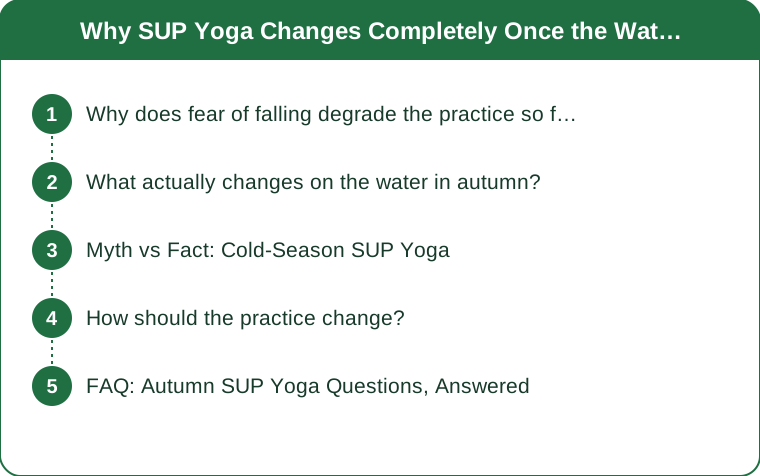
Why does fear of falling degrade the practice so fast?
Because balance is learned at the edge, and fear moves you away from the edge without telling you.
When falling is cheap, you explore. You take the pose slightly further, you shift weight further forward, you find the actual limit and then you find it again a little further out next week. That process is what builds balance on an unstable surface.
When falling is expensive, you stop exploring and start protecting. The changes are small and mostly invisible: a slightly wider stance, a slightly lower centre of gravity, a hesitation before committing weight, and a habit of stopping just short of the position that would teach you something.
The result is a session that feels fine while you are doing it and produces no progress. People typically notice this a month later as a plateau, and blame the weather or their fitness.
There is a second mechanism too. Anticipating cold water changes your breathing. It gets shallower and higher in the chest, which raises your centre of mass, tightens the shoulders, and makes small corrections harder. Cold-anticipation posture is genuinely different from warm-water posture, and it makes you less stable, which makes falling more likely, which reinforces the anticipation.
What actually changes on the water in autumn?
Four things, and only one of them is temperature.
Wind. Autumn is windier, and a paddleboard is a large flat sail. A breeze that was irrelevant in July moves the board continuously in September, so you are practising on a surface with a constant drift rather than a still one. Anchoring becomes much more valuable, and an unanchored autumn session is often just a wind-management session.
Water surface. Cooler air over warmer water produces morning mist and often glassier conditions early, then more chop as the day warms. The best conditions of the day move earlier in autumn, which is inconvenient because the air is coldest then.
Light. The sun is lower and the days are shorter. A session that ended comfortably at 6pm in August ends in dusk in late September, and being on the water in fading light with wet kit is where autumn sessions go wrong.
Your grip. Cold hands and cold feet lose fine sensation, and a large part of board balance comes from small feedback through the soles of your feet. This is a real and underrated effect - the same practitioner is measurably less stable with cold feet, independent of any fear.

Myth vs Fact: Cold-Season SUP Yoga
Myth: You should stop when the water drops below a certain temperature. Fact: You should change what you wear and how long you stay, not stop. Plenty of people practise into late autumn comfortably with the right layers, and the water is warmer in September than it was in June.
Myth: A wetsuit ruins the practice. Fact: A thin flexible wetsuit or a neoprene top restricts less than people expect, and the confidence it buys more than pays for the restriction. The restriction is real in deep twists; the hesitation it replaces was worse.
Myth: Falling in is a sign of a bad session. Fact: It is a sign you were working at your limit, which is the only place progress happens. A session with zero falls in October usually means you spent an hour repeating things you can already do.
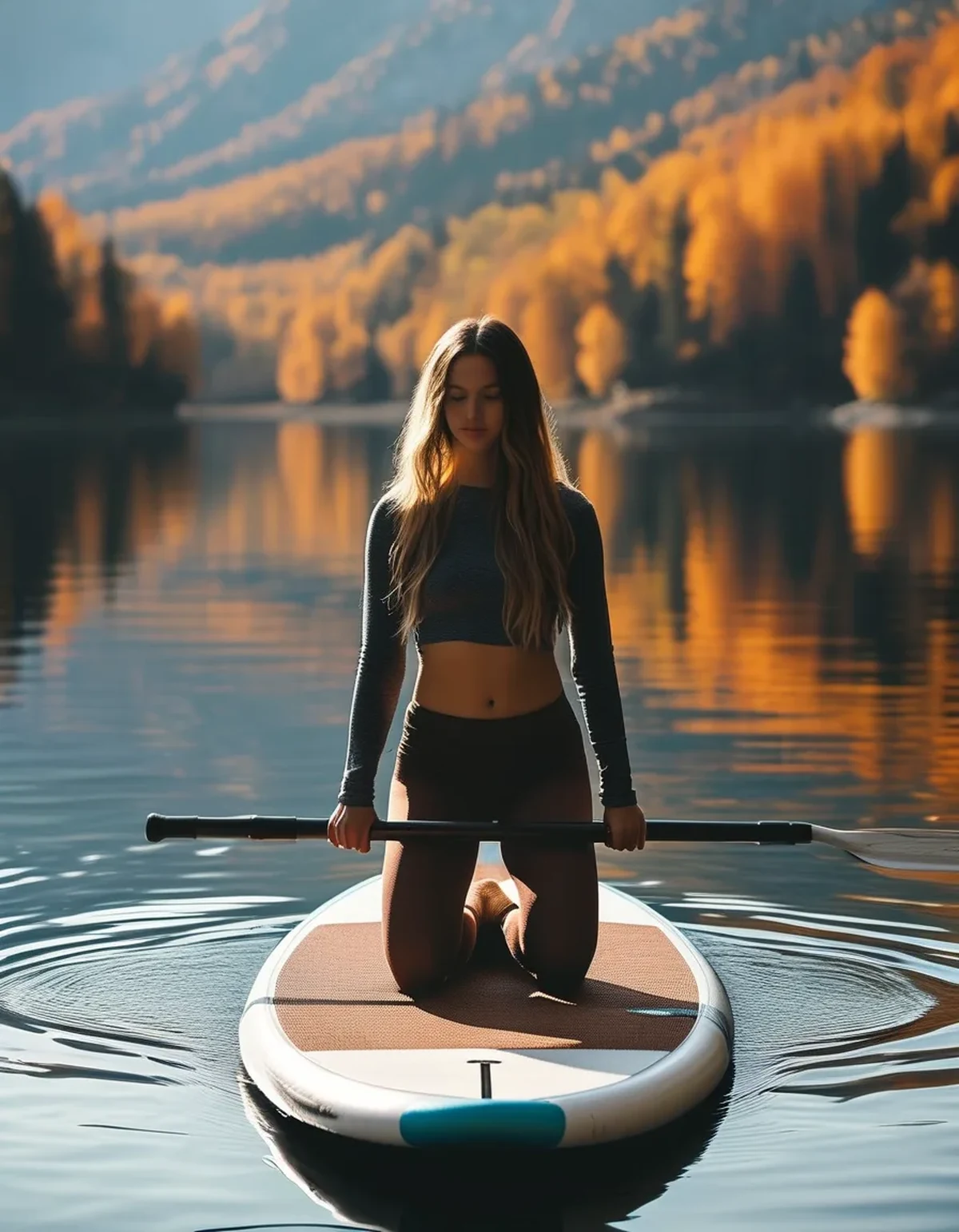
Myth: Kneeling variations are a downgrade. Fact: They are a different set of demands and they are what makes cold-season practice viable. Lower centre of gravity, more contact with the board, and a much better platform for building the core control that standing poses need.
Myth: You can judge the water by dipping a hand in. Fact: Hands are poor thermometers, especially when the air is cold. Water in the low sixties feels bearable to a hand and produces a genuine cold shock response on full immersion.
How should the practice change?
Make falling cheap, then practise as though it were summer.
Wear the layer. A neoprene top or a thin full wetsuit for water below about 65F, and a thermal rash guard above that. The point is not comfort while dry - it is that a fall becomes an inconvenience rather than an event.
Take one deliberate fall at the start. This sounds absurd and it is the single most effective thing on this list. Getting wet on purpose in the first two minutes removes the anticipation entirely, and the rest of the session is played from a completely different mental position.
Anchor the board. Wind drift is the main autumn variable and an anchor removes it. It also means a fall does not turn into a swim after a board that is travelling downwind faster than you can swim.
Shorten the session and raise the intensity. Forty focused minutes beats ninety in autumn. Cold builds slowly, and the last twenty minutes of a long cold session are usually low quality anyway.
Sequence differently. Start with kneeling and low poses while your hands and feet are still fully sensitive, move to standing work in the middle when you are warmest, and finish low. The common summer sequence of standing work at the end is exactly backwards for cold conditions.
And pack for the exit. A dry bag with a full change of clothes, a hat, and a warm drink, left on the shore. This is what converts a fall from a session-ending problem to a two-minute inconvenience, and it changes how you practise even on the days you stay dry.
FAQ: Autumn SUP Yoga Questions, Answered
How cold is too cold to keep practising?
There is no single number - it depends on your kit, your experience, and whether anyone is with you. A reasonable rule is to stop when you cannot manage a full immersion comfortably in what you are wearing, and always practise with someone else or within easy reach of shore in cold conditions. This is general guidance rather than personal advice.
Should I switch to a different board for autumn?
A wider or more stable board is a genuine help for cold-season practice and many people keep one for exactly this. It is not essential, and anchoring plus adjusted sequencing solves most of what a wider board would.
What about practising on a river or the sea rather than a lake?
Moving water and tidal water raise the stakes considerably in autumn, since a fall can separate you from the board quickly. Flat sheltered water is the right choice for this practice in cold conditions, and a leash is not optional.
TL;DR:
- Cold water makes falling expensive, and expensive falls quietly stop you practising at the edge where balance is built.
- Anticipating cold changes your breathing and raises your centre of mass, so fear makes you genuinely less stable.
- Wind, light, and cold feet change the session as much as temperature does.
- Wear the layer, anchor the board, take a deliberate fall early, shorten the session, and pack a full change for the exit.
Autumn does not end SUP yoga. It ends the version of it where getting wet does not matter, and the fix is to buy that back rather than to practise more carefully.
See It in Motion
Seen here: High Waist Yoga Leggings with Inner Pocket — shop it on bubblelime.com
Keep Reading
This article is for general informational and styling purposes only. Fit, sizing, and product availability may vary.