Where You Put the Paddle Changes Your Balance More Than Your Stance
Quick Answer: A paddle laid across the board adds weight, windage and an obstacle in whichever position you leave it. Placed off-centre it creates a permanent tilt you compensate for unconsciously; placed across the nose it catches wind and turns the board. The reliable answer is flat along one rail, blade toward the nose, handle within arm’s reach — and securing it changes the stability of the whole session more than any stance adjustment.
You have fixed your gaze point, widened your stance and slowed your transitions.
You are still tippier than the person next to you, who is doing none of that.
Look at where their paddle is, and then look at where yours is. It is very often the whole difference.
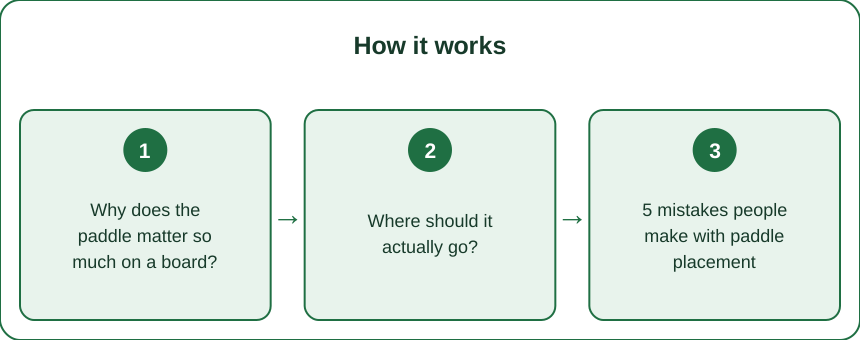
Why does the paddle matter so much on a board?
Because a paddleboard is a balance system with very little margin, and the paddle is a significant proportion of what is on it.
A touring or yoga paddle weighs somewhere between roughly 0.7 and 1.5kg depending on material. On a stable yoga board with a person on it, that sounds negligible.
It is not, for three reasons.
1. Leverage. Weight placed at the rail — the edge of the board — has far more effect on tilt than the same weight in the middle, because it is acting at a distance from the centreline. A paddle at the edge is a small weight with a long lever.
2. Windage. A paddle blade is a flat surface, and on the water there is almost always some wind. A blade oriented across the wind acts as a small sail — enough to slowly rotate a board through a long hold, which is the drift people usually blame on current.
3. Obstruction. In transitions you move hands and feet across the board, often without looking. A paddle in the wrong place turns a smooth transition into a step-around, and step-arounds are where people go in.
Where should it actually go?
Flat along one rail, blade toward the nose, handle within reach of your hand when you are in a low position.
Why along the rail rather than across the board:
A paddle lying across the board — nose to tail across the middle — sits directly in the path of every hand and foot placement. It is the most common position and the worst one.
Why the blade toward the nose:
The blade is the wide, wind-catching part. Toward the nose it sits in the narrower part of the board where you are least likely to place a hand, and it is oriented more along the wind than across it in most conditions.
Why the handle within reach:
Because the moment you need the paddle — drift, a boat wake, a change of plan — you need it immediately, and reaching to the far end of the board to get it is itself a balance event.
Which rail: the downwind one, if there is any wind. That way the paddle is on the side the board is already being pushed toward, and its weight helps rather than compounds.
And flat, not on edge. A paddle resting on its edge is unstable, will shift during the session, and presents the maximum blade area to the wind.
5 mistakes people make with paddle placement
1. Leaving it across the middle of the board. The default position, and the one that interferes with every transition. If you take nothing else from this, move it to the rail.
2. Letting it float on a leash. Some people clip the paddle and let it trail in the water. It creates drag on one side, which turns the board slowly and continuously, and the drag increases as you drift. A paddle in the water is a rudder you did not ask for.
3. Putting it under the deck bungees at the nose. Better than loose, but the nose is where the board is narrowest and lifts most in chop. Weight there makes the board pitch more, and the blade is fully exposed to wind.
4. Not securing it at all in wind. An unsecured paddle on a board in a breeze will move. It usually moves at the moment you are inverted or in a hold, which is the worst possible time to hear something sliding.
5. Changing where it goes between sessions. Balance is partly habit. If the paddle is in a different place every time, you cannot build unconscious awareness of where it is, and you will look for it during transitions. Pick a position and keep it.
The fourth one causes more falls than any technique error, and it is entirely preventable with a single bungee.
Does this change with conditions?
Considerably, and late summer into autumn is when it starts to matter more.
In flat, still conditions, placement matters mainly as an obstruction. Along the rail is enough and you can be relaxed about which side.
In wind, all three factors compound:
- Put it on the downwind rail so its weight works with rather than against the drift.
- Secure it under a bungee or strap. Not optional above a light breeze.
- Consider a shorter blade orientation — laid flat, blade angled so the face is not presented to the wind.
In chop or boat wake, move it further toward the tail than the nose. The nose pitches more, and weight at a pitching end amplifies the movement.
The seasonal note: late summer into early autumn brings more variable wind and more afternoon breeze than the still mornings of midsummer. Sessions that were fine unsecured in July need the paddle strapped down by September, and this catches people out because nothing about their technique has changed.
Cold water adds a practical reason too. As the water cools, an unplanned swim to retrieve a drifting paddle stops being a minor inconvenience. Securing it is worth doing for that reason alone.
What about anchoring and the paddle together?
They solve different problems and people often confuse them.
An anchor stops the board translating — drifting across the water. It does nothing about rotation or tilt.
Paddle placement affects rotation and tilt — the board turning slowly under you, or sitting slightly heavy on one side.
You need both for long holds, and this is the combination that makes extended sequences possible on open water.
A practical sequence for setting up:
- Paddle to your spot.
- Set the anchor first, from a kneeling position.
- Let the board settle and find its natural orientation to the wind — a minute is enough.
- Then place the paddle on the downwind rail, blade toward the nose, secured.
- Start from kneeling and work up.
Why in that order: the board’s orientation relative to the wind is only stable once anchored. Placing the paddle before you know which rail is downwind means getting it wrong half the time.
One thing to check on every setup: that the anchor line is not running under the board or across the rail where the paddle sits. Line and paddle in the same place is an entanglement waiting to happen, and untangling it while balancing is exactly the scenario to avoid.
FAQ: Paddle Placement, Answered
Can I just leave the paddle on shore?
Only if you are practising in water shallow enough to walk back through and close enough to be certain about. Otherwise no — a board without a paddle is not a controllable craft, and drift happens faster than people expect.
Does a lighter carbon paddle actually help balance?
Marginally for the weight, more meaningfully because lighter paddles are usually slimmer and present less blade area to wind. It is a real but small improvement, and placement matters much more than material.
Should the blade face up or down when laid flat?
Blade down against the deck is more stable and presents less area to wind. It also means the grip is oriented ready to pick up, which is the position you want when you need it quickly.
TL;DR:
- The paddle adds weight at a lever, wind area, and an obstacle — all three affect balance more than stance does.
- Place it flat along the downwind rail, blade toward the nose, handle within reach.
- Never leave it across the middle of the board, floating on a leash, or unsecured in wind.
- Anchor first, let the board settle, then place the paddle — you cannot know which rail is downwind before that.
- Autumn brings more breeze; sessions that were fine unsecured in July need strapping down now.
If you have been working on your balance and getting nowhere, spend one session with the paddle deliberately placed and secured before you change anything else about your practice. It is a thirty-second adjustment and it removes a variable most people have never considered was there.
See It in Motion
Seen here: Super High Waist Embossed Yoga Leggings with Inner Pocket — shop it on bubblelime.com
Keep Reading
This article is for general informational and styling purposes only. Fit, sizing, and product availability may vary.