Why You Keep Falling Off During SUP Yoga Even in Perfectly Calm Water
Quick Answer: Board inflation pressure (PSI) has a bigger effect on SUP yoga stability than water calmness does — an under-inflated board flexes and wobbles under weight shifts regardless of how still the water is, which is why falling repeatedly even in calm conditions often points to board firmness, not balance skill or water conditions.
You deliberately chose the calmest lake morning available, assuming that would remove the main variable. Falling repeatedly anyway suggests the water was never actually the biggest factor working against you.

Why would board inflation matter more than water calmness?
An under-inflated inflatable SUP board flexes and bows slightly under body weight, especially as you shift weight during yoga poses, creating a subtly unstable platform that moves beneath you independent of the water’s surface conditions entirely. A properly firm board (typically 12-15 PSI depending on the specific board) stays rigid under weight shifts, providing a stable platform regardless of whether the water itself is calm or slightly choppy.
How can you tell if your board is under-inflated for yoga specifically?
Press firmly on the board’s surface with your hand — a properly inflated board should feel taut and show minimal give, almost like a firm mattress, while an under-inflated board will noticeably flex and dip under hand pressure. Many boards rented or borrowed for general paddling are inflated to a lower, more comfortable-for-paddling PSI that’s specifically inadequate for the more static weight-shifting demands of yoga poses.
Does board width and length also matter as much as inflation?
Yes, as a secondary factor — wider boards (typically 32+ inches) provide a larger stable base than narrower touring-style boards, which matters more for yoga’s static poses than for straightforward paddling. If you’re borrowing or renting specifically for SUP yoga, requesting a wider yoga-specific board in addition to checking PSI addresses both major stability factors.
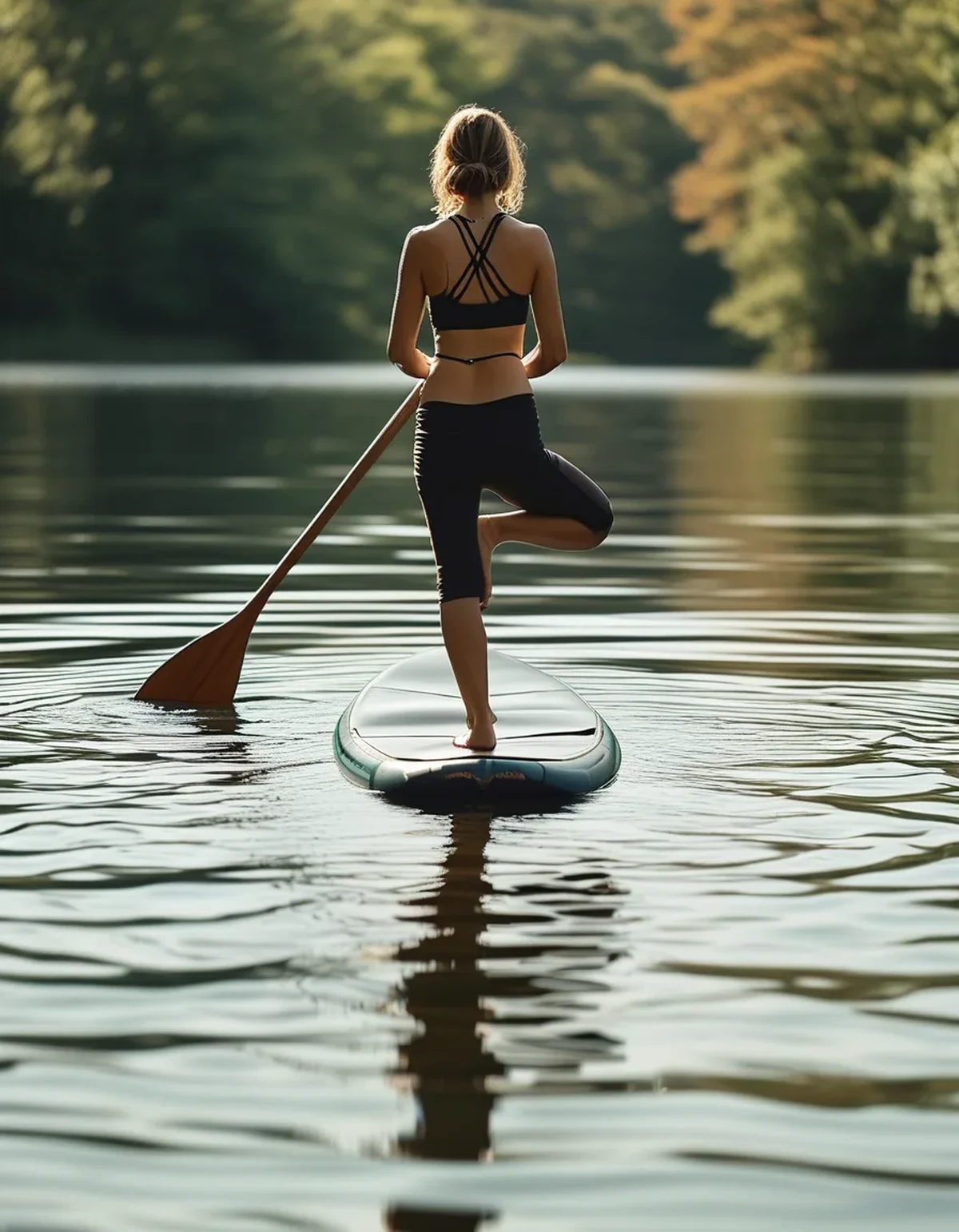
What Nobody Tells You About Foot Positioning During Poses
Here’s a detail rarely coached explicitly in beginner SUP yoga classes: keeping your feet and weight distributed toward the board’s center point, rather than the very front, back, or sides, meaningfully improves stability regardless of board firmness — the center of an inflatable board flexes least under weight, so poses attempted too far toward either end amplify whatever flex the board’s PSI level allows.
Myth vs Fact: SUP Yoga Stability
Myth: Calm water alone guarantees a stable SUP yoga experience. Fact: Board inflation (PSI) and width matter as much or more than water conditions for actual stability.
Myth: Falling repeatedly on calm water means your balance skill is the problem. Fact: An under-inflated or narrow board can make even skilled balance feel unstable regardless of water.
Myth: Any inflatable SUP board works fine for yoga if it’s inflated at all. Fact: PSI level matters specifically — boards inflated for casual paddling are often too soft for yoga’s static poses.
FAQ: SUP Yoga Stability, Answered
What PSI should I aim for specifically for SUP yoga?
Most yoga-specific inflatable boards recommend 12-15 PSI, noticeably firmer than some general paddling boards are inflated to by default.
Is a hard (non-inflatable) board more stable than an inflatable one for yoga?
Often yes, since hard boards don’t have an inflation-dependent flex issue at all, though inflatables designed specifically for yoga at proper PSI can perform comparably.
Does staying near the board’s center really make a noticeable difference in poses?
Yes, many practitioners report a clear stability improvement simply from consciously centering their weight during transitions and holds.
TL;DR:
- Board inflation pressure (PSI) affects stability more than water calmness does for SUP yoga specifically
- Under-inflated boards flex and wobble under weight shifts regardless of how still the water is
- Wider, yoga-specific boards provide a more stable base than narrower touring boards
- Keeping weight centered on the board during poses reduces flex-related instability
Before your next session, press-test the board’s firmness by hand and check the PSI if possible — a properly firm board addresses the falling issue far more directly than waiting for calmer water.
See It in Motion
Seen here: Super High Waist Embossed Yoga Leggings with Inner Pocket — shop it on bubblelime.com
Keep Reading
This article is for general informational and styling purposes only. Fit, sizing, and product availability may vary.