Why Wind Direction Matters More Than Speed for SUP Yoga
Quick Answer: Wind speed determines how much force is on you; wind direction determines whether that force pushes you toward safety or away from it, and whether it arrives as steady pressure or as chop. An offshore wind at 8 to 10 mph is the genuinely risky condition because the water near shore looks deceptively flat while the wind is carrying you out. Check direction relative to the shoreline before you check the number.
You looked up the forecast, saw a modest number, and got out there to find a session that was nothing like the one the number implied.

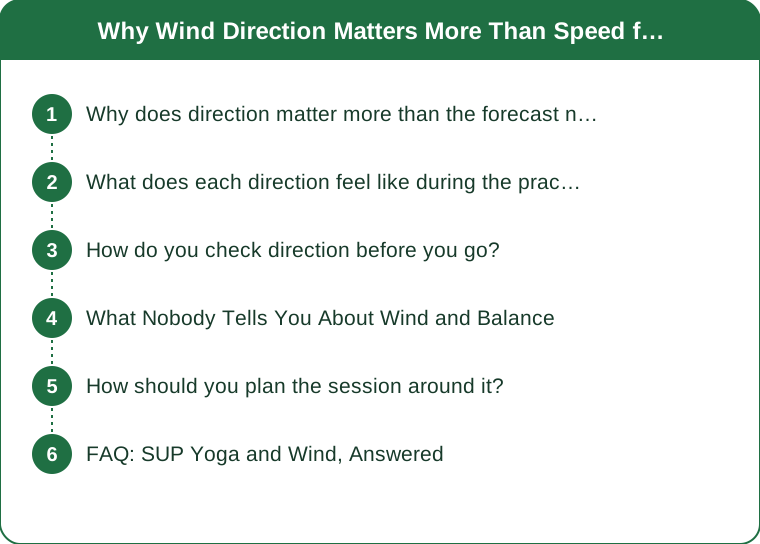
Why does direction matter more than the forecast number?
Because a board is a sail, and what a sail does depends entirely on which way it is pushed.
A paddleboard with a person kneeling on it presents a large, light, flat object to the wind and offers almost nothing underwater to resist sideways drift. There is no keel, no ballast, and very little draft. This is the single most wind-affected craft on the water, and it is why the same breeze that a kayaker barely notices moves you continuously.
So the relevant question is not how hard you are being pushed. It is where the push takes you, and what the water is doing when it gets there.
Offshore wind — blowing from land out to water — is the dangerous case. Two things combine badly. First, water near the shore is sheltered and looks calm, because wind needs distance over water to build waves. Second, that same wind is carrying you steadily away from land, and the further out you drift the rougher it gets and the harder it becomes to paddle back into it. You cannot see the problem from the beach, which is exactly what makes it a problem.
Onshore wind — from water toward land — is far more forgiving. It looks worse, because the waves are visible right where you launch. It also returns you to shore if anything goes wrong, which is the single most valuable property any wind condition can have.
Cross-shore wind is the middle case: it keeps you roughly parallel to land but drifts you continuously along it, so you finish somewhere other than where you started.
What does each direction feel like during the practice?
Different enough that they may as well be different sports.
In an offshore breeze, near shore, the water is glassy and the practice initially feels easy. The board rotates, though — it wants to lie broadside to the wind, so you find yourself continuously reoriented mid-pose. Then, twenty minutes in, you look up and the shoreline is much further away than you expected. The drift is silent and it does not stop.
In an onshore breeze, you get chop at the launch, the board pitches, and balance work is genuinely harder from the first minute. What you do not get is drift away from safety. Most people find this the more tiring session and the less worrying one.
In cross-shore wind, the board wants to weathercock — pivot so one end points into the wind — and you spend the session correcting rotation. This is the condition that makes people think their balance has got worse, when in fact the board is turning underneath them.
And in genuinely light wind of any direction, the interesting thing is that glassy water is harder to balance on than lightly textured water, because there is no continuous small feedback to read. Perfectly flat conditions remove the information your body was using.
The practical read: if you keep having to reposition your board rather than your body, that is wind, not skill.
How do you check direction before you go?
Two minutes with a forecast and a map, and one look at the water.
Get the wind direction, not just the speed. Forecasts state direction by where the wind is coming from — a west wind blows from west to east. Then compare that to which way your shoreline faces. If the wind is coming from the land side, that is offshore for you.
Learn your specific spot’s offshore direction once and it never changes. For a beach facing east, a west wind is offshore. Write it on a note in your phone. This single fact is the most useful thing you can know about a launch site.
Then read the water surface, which is more reliable than any forecast:
- Glassy right at the shore with texture further out — that is offshore. Treat it as the warning it is.
- Waves breaking toward you at the launch — onshore.
- A band of ripples running parallel to the beach — cross-shore.
- Debris, foam, or weed lines moving steadily away from shore — offshore drift, visible.
Check the trend too. Afternoon sea breezes build predictably in late summer, often turning a calm 8am into a difficult 2pm, and thermal winds in lakes and reservoirs do the same. A morning session in the same forecast window is consistently the easier one.
And know your escape option. If the wind picks up, lie prone and paddle with your arms — a prone board presents a fraction of the wind profile of a kneeling one and it is dramatically easier to make ground into a breeze. This is the single most important skill on this page.

What Nobody Tells You About Wind and Balance
Steady wind is easier than gusty wind at a higher average. Your body adapts to constant pressure within a few breaths. A 12 mph steady breeze is more workable than a 6 mph wind gusting to 14, because every gust is a new correction with no warning. Forecasts that list a gust figure are telling you the number that matters.
Wind against current is the roughest water you will meet. When a breeze blows against a tidal or river flow, the waves stack up short and steep for the same wind speed. A modest wind opposing a modest current produces water that looks like a much bigger day. If your spot has any tidal movement, look up the direction of flow as well.
Your own body is most of the sail. Standing in a wind is far harder than kneeling, and kneeling is harder than lying down — not because balance changes, but because your surface area does. Dropping to your knees in a gust is not a retreat, it is a reduction in the force acting on you, and it works instantly.
Anchoring changes the problem rather than removing it. An anchored board stops drifting and begins to swing on its line and to take chop side-on, which some people find harder than free drifting. Anchoring is a genuinely good tool for offshore-risk days and it is not a comfort upgrade.
Cold water raises the stakes of every wind mistake. As water temperatures drop through autumn, a drift that would be inconvenient in August becomes a real problem in October, because time in the water matters much more. The wind rule you can relax in summer is the one to tighten now.
How should you plan the session around it?
Pick the direction first, then the pose sequence, then the exit.
Set a personal wind ceiling and treat it as a rule. For most people practising SUP yoga, anything above roughly 10 to 12 mph stops being a yoga session and becomes paddling practice, and offshore should have a much lower ceiling than onshore — many experienced paddlers simply do not go out in offshore wind alone at all.
Choose the launch that faces the wind. If you have two spots available, the one with an onshore breeze is the correct choice every time, even if the water there looks rougher. Visible chop with a safe drift beats invisible calm with an unsafe one.
Adapt the sequence rather than fighting it. In any real breeze:
- Stay low. Kneeling and seated poses, table top, sphinx, seated twists.
- Drop the standing balance work. It is the first thing wind takes and the last thing worth insisting on.
- Face into the wind where you can — a board pointed into the breeze holds its heading; a board broadside to it rotates continuously.
- Shorten the holds. Wind means constant micro-corrections, and fatigue arrives noticeably sooner.
Always wear the leash and a PFD, and on any offshore-risk day, tell someone your plan and expected return. The leash is what keeps the board with you, and the board is your flotation, your visibility, and your ride home.
And check the exit before you launch. Know where you can get out downwind of your start point, because in a breeze that is the landing you will actually make.
FAQ: SUP Yoga and Wind, Answered
What is a safe wind speed for SUP yoga?
There is no universal number because direction, water temperature, fetch, and your own paddling strength all change it. As a working guide, most people find balance work realistic below about 8 to 10 mph, and offshore wind deserves a stricter limit than onshore at the same speed. The better question is whether you could paddle back against it if you had to.
Does an anchor solve wind problems?
It solves drift and adds two new things: the board swings on its rode, and it takes chop side-on rather than adjusting to it. On a day with any offshore component, an anchor is a sensible piece of equipment. On a merely choppy onshore day, many people find it makes the practice harder, not easier.
Why is glassy water harder to balance on than I expected?
Because you balance partly by reacting to small continuous movement, and glass removes it — so your corrections come later and larger. Most people also unconsciously stiffen when the surface is perfectly still. Soft knees, a moving gaze on the horizon rather than the board, and a slower breath all help. If you are new to this, practise in ankle-deep water near shore first, and never practise alone in conditions you have not seen before.
TL;DR:
- A paddleboard is effectively a sail with no keel, so wind direction decides where the force takes you
- Offshore wind is the dangerous case: flat-looking water near shore while it carries you steadily out
- Onshore wind looks worse and is far safer, because it returns you to land if anything goes wrong
- Learn your launch site’s offshore direction once, read the water surface, and check gusts rather than averages
- Drop to your knees or prone to shed wind load, always wear the leash, and know your downwind exit
The forecast number tells you how hard you will be pushed. The direction tells you whether being pushed is a nuisance or a problem, and that is the part worth checking first.
See It in Motion
Seen here: Racerback Tank Top - White — shop similar styles on bubblelime.com
Keep Reading
This article is for general informational and styling purposes only. Fit, sizing, and product availability may vary.