Why Warm-Water SUP Yoga Sessions Feel Easier, But Actually Build Less Balance Long-Term
Quick Answer: Calm, warm, glassy water conditions — often the most comfortable and popular time to practice SUP yoga — require the least amount of ongoing micro-correction from the body, which means the sessions that feel easiest are frequently doing the least to actually build the balance and core stabilization skills SUP yoga is known for.
The calmest, warmest days on the water always feel like the best SUP yoga sessions — but the board barely moves, and that’s exactly the problem for building real balance.
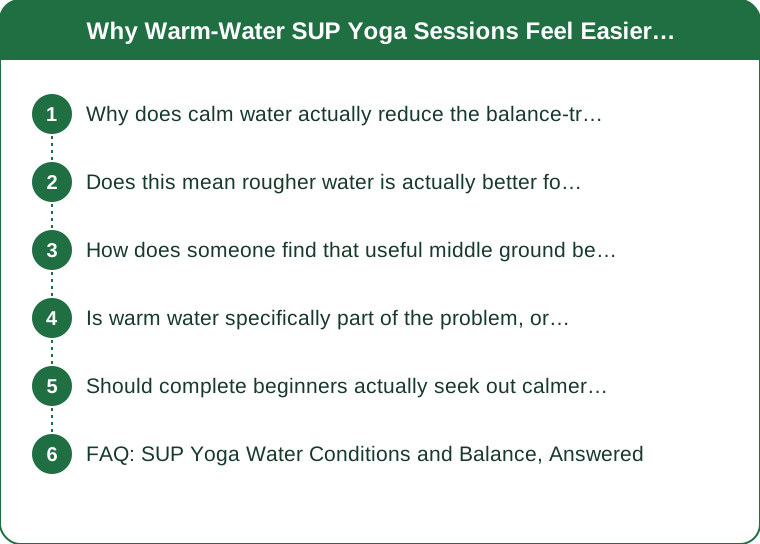
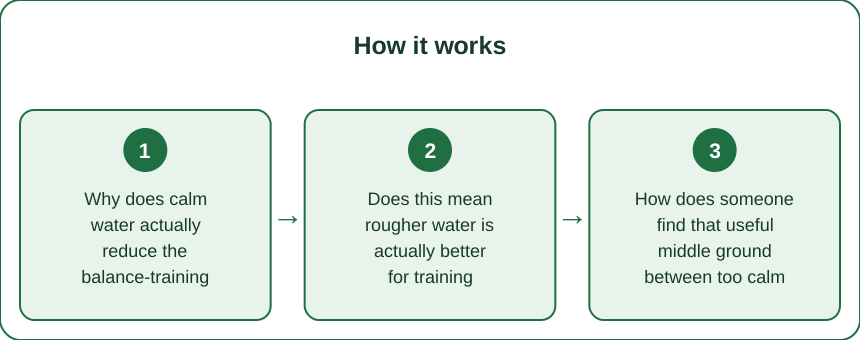
Why does calm water actually reduce the balance-training effect?
Balance improvement comes largely from the body making constant small, unconscious corrections in response to instability, and glassy, calm water gives the board very little to correct against — the nervous system simply isn’t being challenged the way it would be on water with even mild chop or gentle current, which means fewer of the micro-adjustments that actually drive balance adaptation over time.
Does this mean rougher water is actually better for training purposes?
Up to a point, yes — mild chop or gentle movement gives the body meaningfully more to respond to and adapt from, but conditions that are too rough shift the challenge from balance training into pure survival and safety management, which stops being productive training and starts being genuinely risky, especially for less experienced practitioners.
How does someone find that useful middle ground between too calm and too rough?
Slightly breezy conditions with small, consistent ripples — rather than glassy stillness or whitecap chop — tend to provide steady, moderate instability that keeps the balance system genuinely engaged without tipping into unsafe territory, making late morning or early afternoon on many bodies of water (once light wind picks up but before conditions get rough) a commonly recommended window.
Is warm water specifically part of the problem, or is it really just about water stillness?
It’s really about stillness, though warm water and calm conditions frequently occur together seasonally and by time of day, which is part of why the two get associated — a cooler day with the same calm, glassy water would present the identical reduced-challenge issue, and a warm day with light chop would offer the same beneficial instability.
Should complete beginners actually seek out calmer water despite this tradeoff?
Yes, initially — building basic comfort, board familiarity, and fundamental pose stability on calmer water first is a reasonable and safer progression before intentionally introducing more instability, meaning the calm-water tradeoff is worth accepting temporarily during the earliest stage of learning, then gradually offset as skill and confidence build.
FAQ: SUP Yoga Water Conditions and Balance, Answered
Can inflation pressure be used to add difficulty instead of relying on water conditions?
Yes — a softer-inflated board (within manufacturer-safe range) adds its own instability similar in effect to mild water chop, which is a controllable way to add challenge on days when water happens to be very calm.
Is there a way to make calm-water sessions more challenging without changing water conditions?
Yes — slower transitions, longer holds in single-leg poses, and closed-eye balance segments (when safe and appropriate) all increase the balance demand independent of what the water itself is doing.
Does this same calm-versus-chop tradeoff apply to balance training on land, like on a yoga mat?
Conceptually yes — a firm, stable mat surface similarly offers less instability challenge than a balance pad or unstable surface, following the same underlying principle that more environmental instability drives more balance adaptation, up to a safe limit.
TL;DR:
- Calm, glassy water requires little ongoing correction, reducing the balance-training stimulus
- Some water movement gives the body genuinely more to adapt to and build stability from
- Conditions that are too rough shift the session into safety management, not useful training
- Warm water isn’t the real factor — water stillness is what actually reduces the challenge
- Beginners reasonably start on calmer water, then intentionally add instability as skill builds
The most pleasant-feeling session isn’t always the one doing the most for actual balance gains.
See It in Motion
Seen here: High Waist Bootcut Yoga Pants with Hidden Pocket — shop it on bubblelime.com
Keep Reading
This article is for general informational and styling purposes only. Fit, sizing, and product availability may vary.