Why SUP Yoga Feels Harder in the Afternoon Than at Sunrise
Quick Answer: Afternoon SUP yoga is harder mostly because of water surface conditions, not your body. Thermal winds typically build between 11am and 4pm, adding chop that forces constant micro-corrections. Boat traffic, warmer air destabilizing your breath rhythm, and accumulated daily fatigue stack on top.
You nailed half moon at 6:45am on Tuesday. On Saturday at 2pm, on the same lake, you could not hold a plank without the board slapping under you.
You did not lose the skill in four days. The water changed.
What actually happens to the water between morning and afternoon?
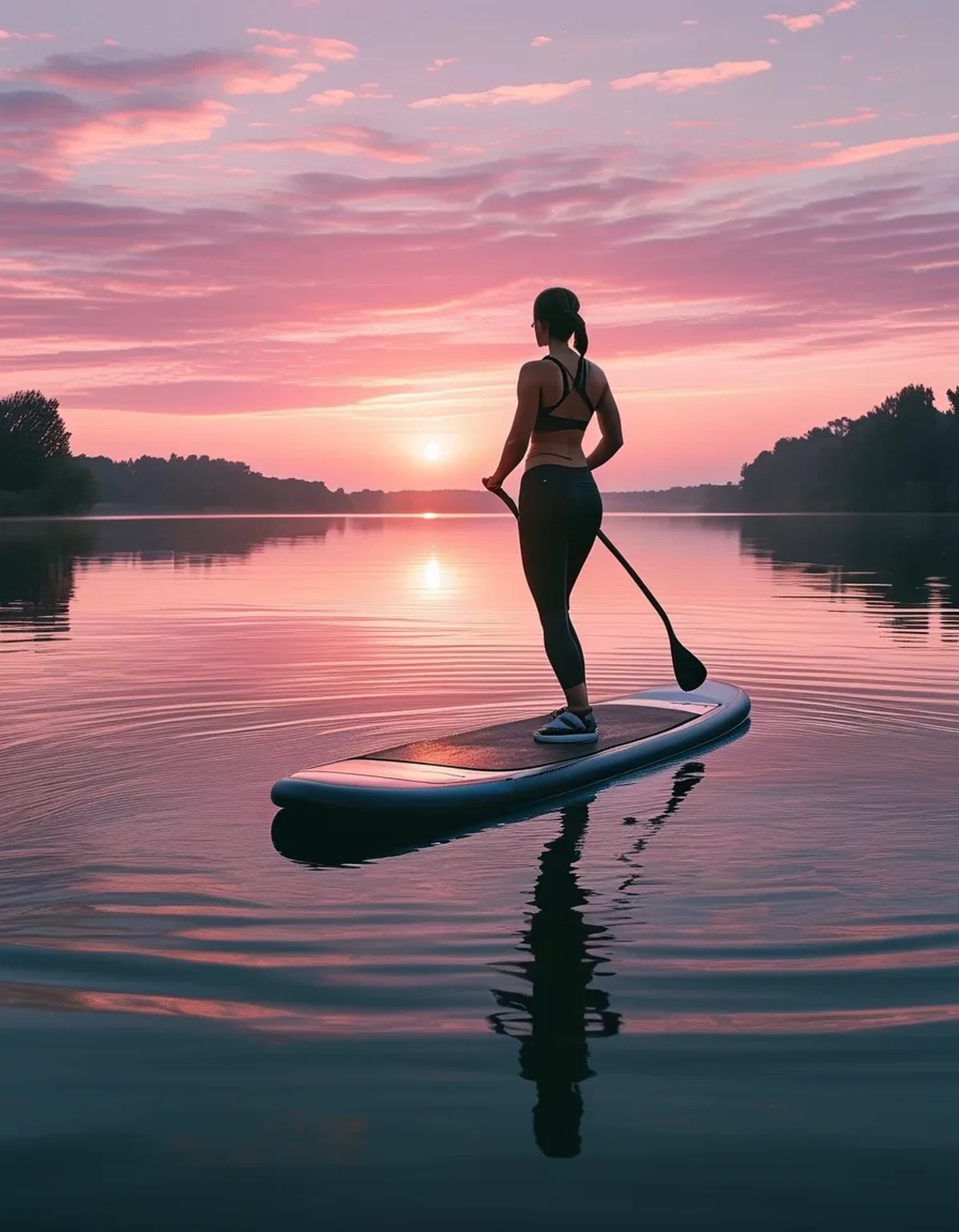
Overnight, air and water temperatures equalize. By dawn the surface is often glassy — what paddlers call a mirror. Your board sits on a nearly static plane, and your balance system only has to manage your own movement.
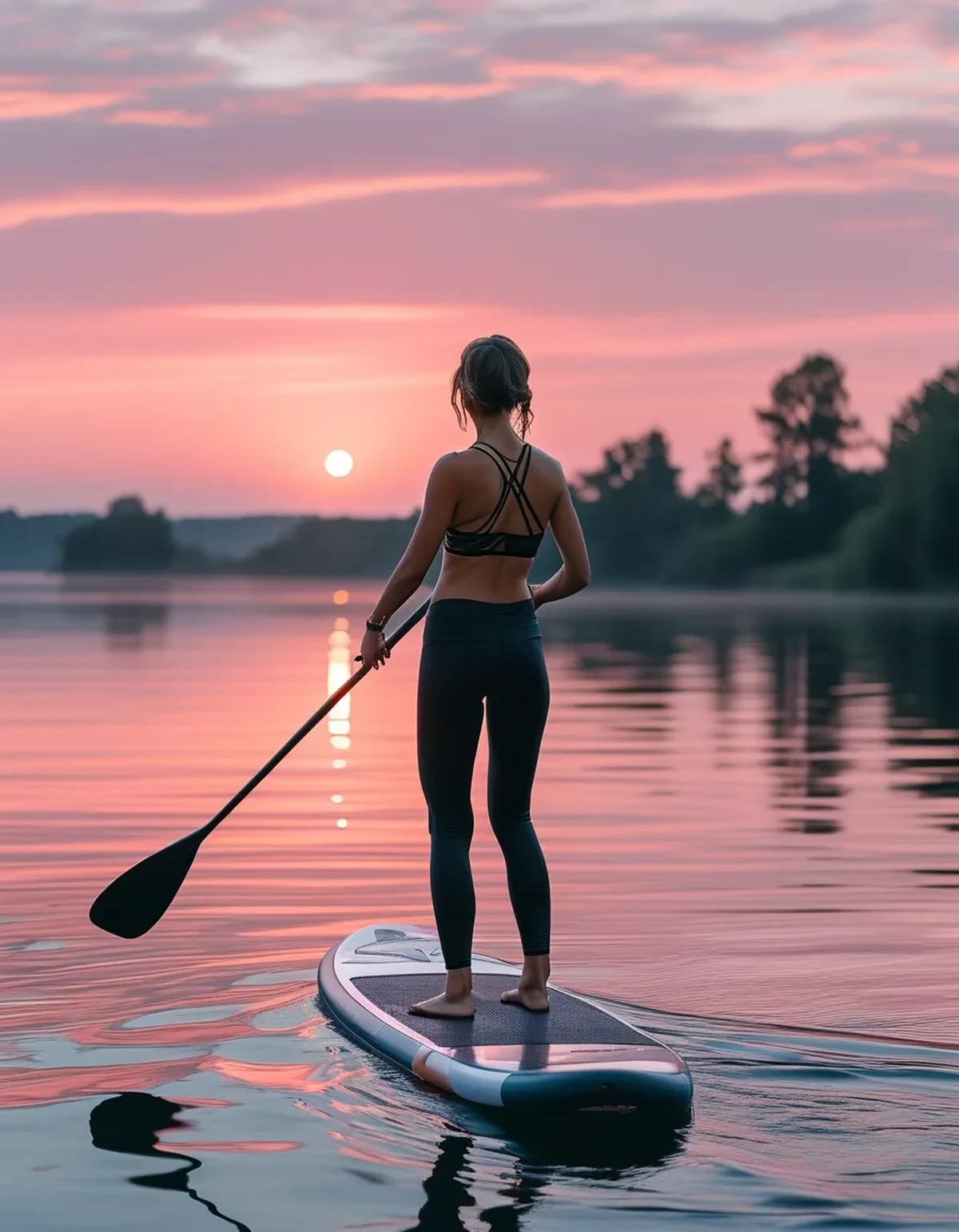
As the sun heats the land faster than the water, air over the shore rises and cooler air pulls in off the water. That thermal gradient produces a predictable onshore breeze that typically starts building around 10 to 11am and peaks mid-afternoon at 8 to 15 mph on many inland lakes.
Even a 6 mph breeze puts a 2 to 4 inch ripple on the surface. That is enough to move your board a few degrees every second or two — meaning your ankles and hips are correcting constantly instead of holding still.
Why does small chop cost so much more energy than it looks like it should?
Balance on a stable surface is mostly a holding task. Balance on a moving surface is a tracking task, and tracking is far more expensive.
On glass, your stabilizers fire in slow, low-amplitude waves. On chop, they fire in rapid bursts — research on unstable-surface training shows stabilizer activation rising 30 to 50 percent compared to firm ground, with most of that in fast-twitch fibers that fatigue quickly.
That is why you feel it as leg burn and shaky hips within 90 seconds rather than as a gradual fade. Your ankles are doing interval work you never signed up for, underneath a pose that is supposed to feel steady.
How much of it is you and not the lake?
Some. By 2pm you have been vertical for six or seven hours, and your ankle and foot stabilizers have already logged the day.
Core temperature matters more than people expect. Practicing in 85°F afternoon air rather than 68°F dawn air raises your heart rate roughly 10 beats per minute at the same effort, and elevated breathing rate is itself destabilizing — every deep exhale shifts your center of mass a little on a board.
Hydration compounds it. A 2 percent drop in body water measurably degrades balance and reaction time, and afternoon paddlers are far more likely to arrive already down a liter than dawn paddlers who just got out of bed.
5 Mistakes Everyone Makes When the Water Turns Choppy
1. Fighting the board instead of the water. Rigid ankles amplify chop. Soft knees absorb it. Let the board move under you a little.
2. Anchoring the gaze on the horizon. A moving horizon feeds your brain conflicting motion signals. Fix your eyes on a point on your own board — the front handle works — in any pose where you need stillness.
3. Staying parallel to the wind. A board sideways to the breeze catches it like a sail. Point the nose into the wind and the same conditions feel roughly half as bad.
4. Keeping the same pose length. Sixty-second holds that worked at dawn will fail at 2pm. Cut to 20 to 30 seconds and add a round instead.
5. Anchoring in open water because it looks prettier. Ten yards of shoreline shelter, behind a point or a dock, can drop chop to almost nothing.
How do you build an afternoon practice that still works?
Do not simply repeat the sunrise sequence later. Design for the conditions you will actually meet.
Reorder the sequence. Put your hardest standing balance work — half moon, dancer, warrior III — in the first 10 minutes, when your stabilizers are freshest, and move seated and kneeling work to the back.
Widen your base by default. Feet at outer edges of the deck pad rather than hip-width. It looks less elegant and it buys you a genuinely larger margin.
Check the forecast for gust spread, not average wind. A steady 8 mph is workable. An average of 6 with gusts to 16 is what actually dumps people, because the correction arrives before you can prepare.
Treat it as a different practice. Afternoon sessions build reactive balance and ankle endurance. Dawn sessions build depth and stillness. Both are worth having; expecting one to feel like the other is the only real error.
FAQ: SUP Yoga Timing Questions, Answered
Is there a second calm window later in the day?
Often yes. Thermal winds usually fade in the last 60 to 90 minutes before sunset as the land cools. Evening glass is a real thing on most inland lakes, and it is far less crowded than dawn.
Does a bigger board fix afternoon chop?
It helps meaningfully. Width matters more than length for yoga — a 34 inch or wider board with a full deck pad is dramatically more forgiving than a touring shape, in any conditions.
Should I anchor or let the board drift?
Anchor in wind, drift in glass. A short anchor line lets the board weathervane into the breeze on its own, which is exactly the orientation you want and one less thing to manage mid-pose.
TL;DR:
- Afternoon difficulty is mostly thermal wind and chop, not lost skill.
- Small ripples turn balance from a holding task into a tracking task, spiking stabilizer fatigue.
- Heat, dehydration, and a full day on your feet stack on top of the water conditions.
- Front-load balance poses, shorten holds, point the nose into the wind, and use shoreline shelter.
If your afternoon sessions have felt like a step backward, they probably were not. The lake was simply a harder training partner that day. Practice at both ends of the clock and you will end up with steadier ankles than someone who only ever paddles on glass.
See It in Motion
Seen here: UPF 50+ Racerback Yoga Tank Top — shop it on bubblelime.com
Keep Reading
This article is for general informational and styling purposes only. Fit, sizing, and product availability may vary.