How to Actually Keep Sunscreen On During a SUP Yoga Session
Quick Answer: Water-resistant mineral or hybrid sunscreen applied 15-20 minutes before getting on the board, reapplied at the halfway point if the session runs past 40 minutes, holds up best against splash and sweat combined — standard sunscreen alone rarely survives a full SUP yoga class.
SUP yoga is uniquely hard on sunscreen: you’re exposed to direct overhead sun with almost no shade, getting intermittently splashed, and sweating from balance effort — three separate mechanisms working together to strip protection faster than any one alone.

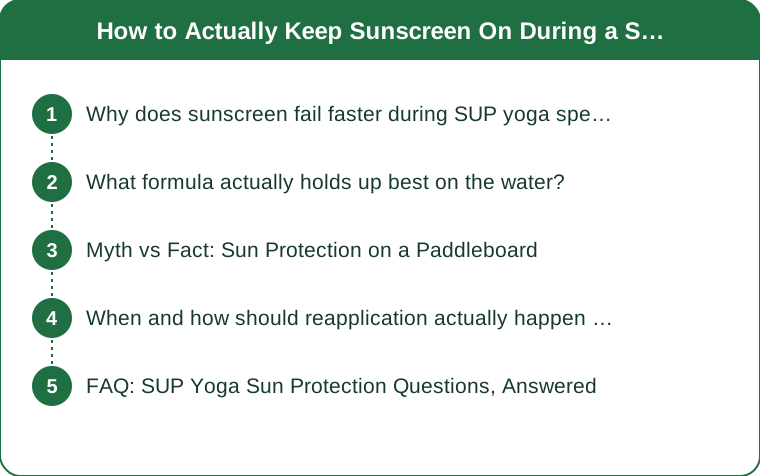
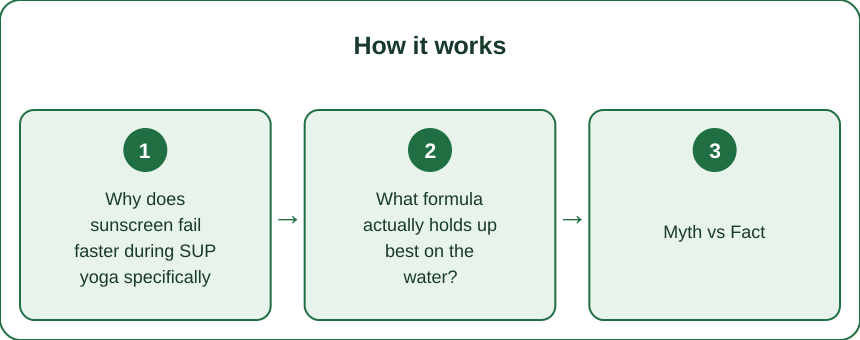
Why does sunscreen fail faster during SUP yoga specifically than regular swimming?
Regular swimming is mostly full submersion, which water-resistant sunscreen is tested for — SUP yoga is intermittent splash plus sweat plus constant sun exposure, a combination most sunscreen testing doesn’t directly replicate. The repeated wet-dry cycling from splash can actually strip more product than continuous submersion does.
This is why sunscreen that works fine for a pool swim can still leave you burned after a SUP yoga class of similar length.
What formula actually holds up best on the water?
Water-resistant mineral sunscreen (80-minute rating) tends to perform most reliably here, since zinc oxide physically sits on skin rather than needing to absorb, making it less prone to rubbing off during poses that involve hand-to-skin or mat contact. A hybrid mineral-chemical formula is a reasonable second option if pure mineral feels too heavy for a full-body application.
Gel or spray sunscreens, while convenient, tend to underperform here since they’re harder to apply evenly over a body about to be repeatedly wet.

Myth vs Fact: Sun Protection on a Paddleboard
Myth: Water-resistant sunscreen doesn’t need reapplication during a single session. Fact: Even 80-minute water-resistant ratings assume continuous submersion testing conditions — the splash-dry cycle of SUP yoga can strip protection faster than that rating suggests.
Myth: Cloudy days over water don’t need sunscreen. Fact: Water reflects a significant percentage of UV rays regardless of cloud cover, meaning exposure on a paddleboard can exceed land-based exposure even when it doesn’t feel sunny.
Myth: A rash guard replaces the need for sunscreen on covered areas. Fact: True for UPF-rated rash guards, but sunscreen is still needed on hands, feet, neck, and face regardless of what’s covered.
When and how should reapplication actually happen mid-session?
If a session runs past 40 minutes, a brief pause to reapply — particularly on the face, shoulders, and tops of feet, the areas most exposed to direct overhead sun — meaningfully reduces burn risk. Toweling off gently rather than rubbing before reapplying helps the new layer adhere better than applying over a wet, disturbed base layer.
Keeping a small waterproof sunscreen stick clipped to the board makes this reapplication realistic instead of something skipped for convenience.
FAQ: SUP Yoga Sun Protection Questions, Answered
How long before getting on the board should sunscreen be applied?
15-20 minutes ahead of time allows most formulas to properly bind to skin, making them more resistant to immediate splash-off.
Are the tops of feet really a common burn spot?
Yes — they’re one of the most overlooked areas during a SUP session since they stay exposed and flat toward the sun for the full duration.
Does a wide-brim hat help if it might fall off during poses?
A secured UPF sun hat or visor with a chin strap works better for SUP yoga specifically, since balance poses make a loose hat impractical.
TL;DR:
- Splash-dry cycling on a paddleboard strips sunscreen faster than full submersion swimming does
- Water-resistant mineral sunscreen holds up most reliably against the combined splash-sweat-sun exposure
- Reapply at the 40-minute mark if the session runs long, especially on feet, face, and shoulders
- A secured UPF hat with a chin strap works better than a loose wide-brim hat for balance poses
Sun protection on a paddleboard needs a different plan than a regular swim — plan for reapplication, not just one strong initial layer.
See It in Motion
Seen here: Racerback Tank Top - White — shop similar styles on bubblelime.com
Keep Reading
This article is for general informational and styling purposes only. Fit, sizing, and product availability may vary.