SUP Yoga Balance and Falling: What's Actually Normal for Beginners
Quick Answer: Falling in during early SUP yoga sessions is genuinely normal, not a sign of poor balance skill — the unstable surface adds a variable that traditional mat yoga balance experience doesn’t prepare you for, and most people improve significantly within 3-4 sessions.
Watching someone glide through a full sequence without a single wobble can make a beginner’s constant falling feel like a personal failure. It’s actually closer to the expected learning curve than an exception to it.

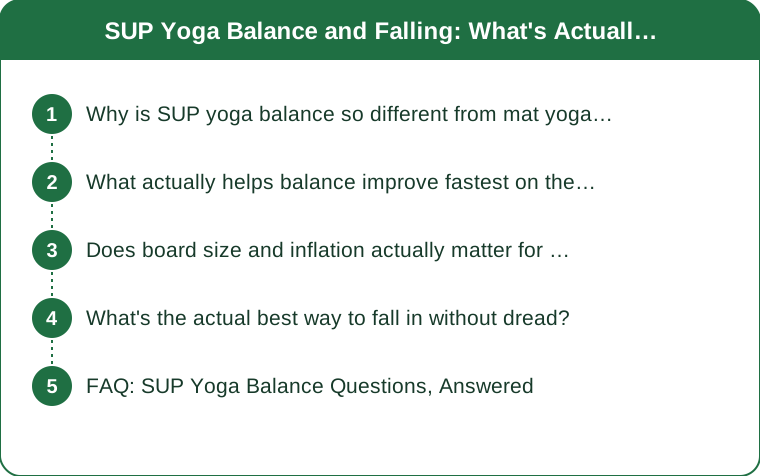
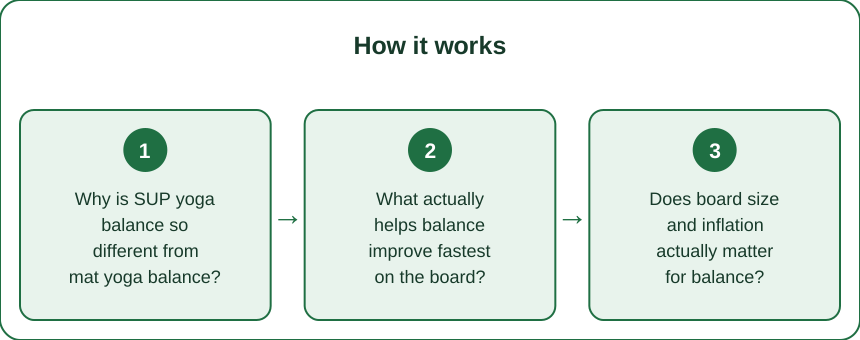
Why is SUP yoga balance so different from mat yoga balance?
A paddleboard moves with your weight shifts, water ripples, and even your breathing in a way a stationary mat never does — this means SUP yoga balance is a genuinely different skill, not just an unstable version of the same skill. Experienced mat yogis often fall just as much as complete beginners in their first few SUP sessions, which is a useful reframe if it feels discouraging.
What actually helps balance improve fastest on the board?
Keeping your gaze on a fixed point on the horizon rather than looking down at the board or water significantly improves stability — this is the single most impactful beginner adjustment. Wider stance poses and a slightly bent knee also help far more than trying to replicate the exact tight alignment used on a stationary mat.

Does board size and inflation actually matter for balance?
Significantly — a wider, longer, and more rigidly inflated board (higher PSI) provides a noticeably more stable platform than a narrow or underinflated one. Many beginner balance struggles trace back to board choice or inflation level rather than a skill gap, which is worth checking before assuming it’s purely a practice issue.
What’s the actual best way to fall in without dread?
Falling to the side into open water, rather than trying to catch yourself and twist awkwardly, is both safer and honestly more comfortable once you stop resisting it. Most experienced SUP yoga practitioners describe falling in as a normal, even fun part of a session rather than something to avoid at all costs — reframing it this way measurably reduces the tension that actually causes more falls.
FAQ: SUP Yoga Balance Questions, Answered
Is it normal to fall in during every SUP yoga class as a beginner?
Yes, especially in the first several sessions — most instructors expect and plan for this, and it’s a normal part of the learning curve rather than a sign of poor balance ability.
How many sessions does it typically take to feel more stable?
Many beginners notice a real improvement by their 3rd or 4th session, as the body adapts to the moving surface in a way that generalizes across poses.
Does being good at regular yoga help with SUP yoga balance?
Somewhat, in terms of body awareness and pose familiarity, but the unstable surface is enough of a different variable that mat yoga experience doesn’t guarantee an easier start.
TL;DR:
- Falling in during early SUP yoga sessions is genuinely normal, not a balance failure
- Fixing your gaze on the horizon is the single most helpful beginner adjustment
- Board width, length, and inflation level meaningfully affect stability
- Falling to the side and letting go of resisting it reduces tension-caused falls
Most people notice a real balance shift by their third or fourth session — the wobbly start isn’t a predictor of where you’ll land.
See It in Motion
Seen here: High Waist Bootcut Yoga Pants — shop it on bubblelime.com
Keep Reading
This article is for general informational and styling purposes only. Fit, sizing, and product availability may vary.