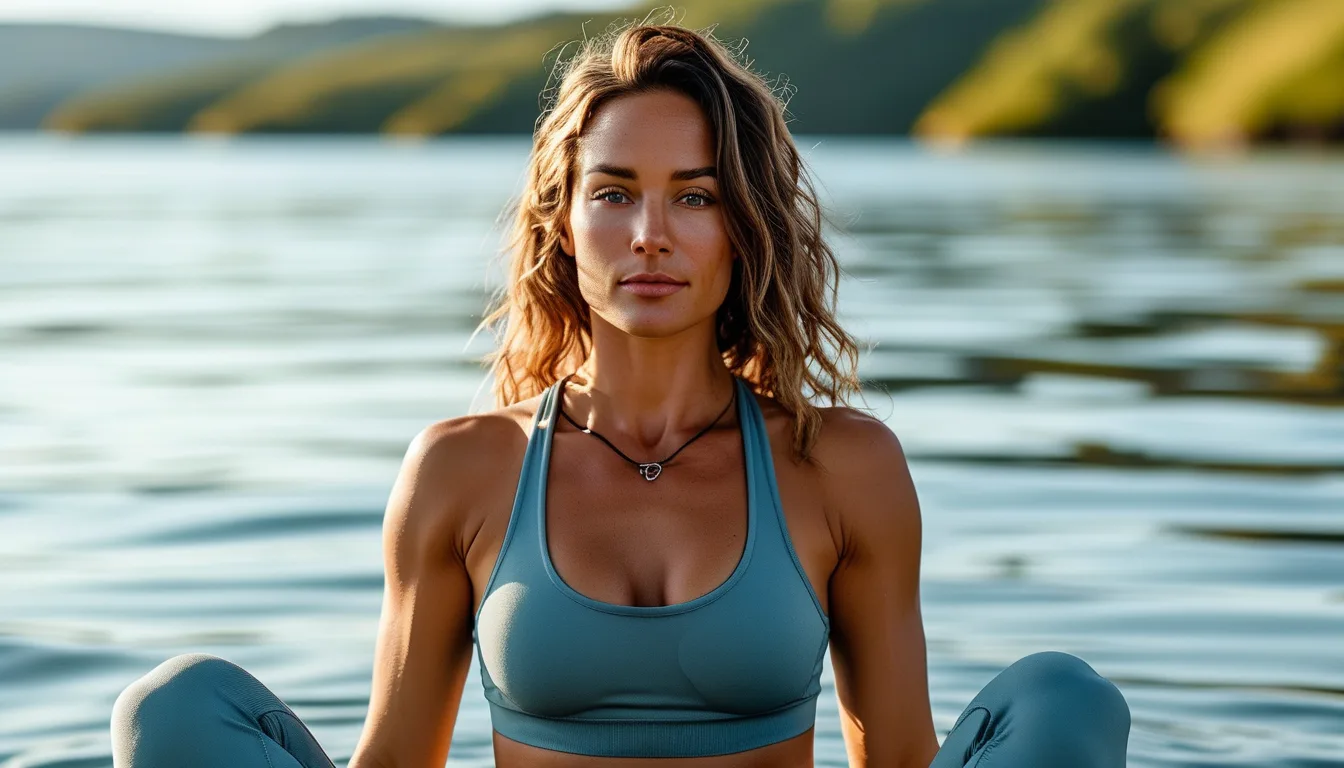
How to Anchor a Paddleboard for SUP Yoga and Why Drift Ruins Your Balance
Quick Answer: An unanchored board never just sits — it drifts with wind and rotates slowly, and your balance system fights that motion the entire session whether you notice or not. A small folding anchor on a line about twice the water depth, clipped to a rear D-ring, turns the board into a stable platform and cuts the invisible workload out of every pose. The setup costs a few minutes and transforms the practice more than any amount of extra balance skill.
Here is why drift is worse than waves, and the exact setup.

Why does drift wreck balance more than waves do?
Because your balance system handles bounce well and slow rotation badly.
Waves are honest. They tilt the board, your ankles and hips respond, and the feedback loop is fast and obvious. Bounce is exactly the challenge people come to SUP yoga for, and the body reads it cleanly.
Drift is dishonest. A breeze pushes the board sideways and spins it slowly at the same time. The rotation is far below the speed your inner ear detects well, but your eyes see the shoreline creeping past. Your visual system and your vestibular system now disagree about whether you are moving, and resolving that argument is real neurological work. It burns focus and balance capacity you could be spending on the pose.
Rotation also keeps changing your reference points. The tree line you set your gaze on in warrior two is somewhere else by the time you transition. Every pose that depends on a fixed drishti — which is most standing balance work — gets its anchor point stolen mid-hold.
And drift moves you somewhere real. Twenty minutes of light breeze relocates an unanchored board surprisingly far. Part of your attention stays on where you are ending up — the dock, the swim lane, another paddler — and attention on navigation is attention off practice.
People blame themselves for a shaky session when the honest culprit was a board that never stopped moving underneath them.
What is the right way to anchor a board for yoga?
Small anchor, short line, rear attachment, quick release. The whole kit fits in a mesh bag.
The anchor: a 1.5 to 3.5 pound folding grapnel or a small mushroom anchor is plenty for a board in calm water. You are not mooring a boat; you are stopping a few pounds of wind pressure.
The line: aim for about one and a half to two times the water depth — enough angle for the anchor to grip without letting the board wander in a wide circle. In ten feet of water, fifteen to twenty feet of line. A float on the line makes retrieval easier and marks it for other paddlers.
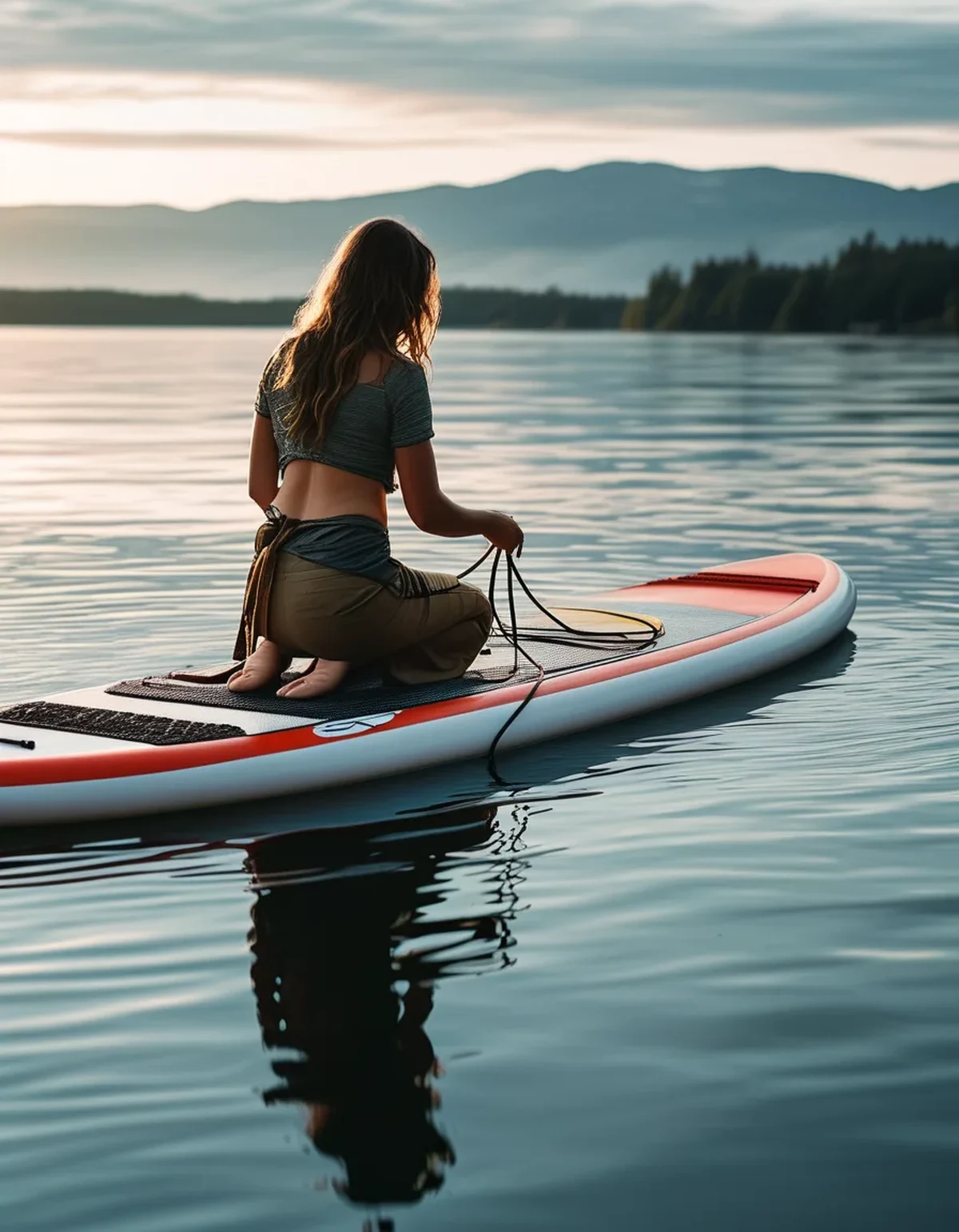
The attachment point: clip to a rear D-ring or the leash plug area, not the centre handle. Anchored from the tail, the board streams nose-away in a line and sits quietly. Anchored from the middle, it swings broadside to the wind and rocks — the exact motion you were trying to remove.
The release: use a carabiner or quick-release clip you can open with one hand. You want to be able to drop the whole line instantly if weather arrives or you need to move.
Setting it: paddle to your spot, lower — never throw — the anchor, let the line pay out, and give the board a gentle back-paddle to set the hooks. Confirm you are holding by watching a fixed landmark for thirty seconds before you start.
Two boards raft up beautifully: anchor one board and clip the second to it side by side. Half the gear, and a steadier platform for both.
What Nobody Tells You About Anchoring for SUP Yoga
An anchored board becomes a weather vane. It will swing until the tail points at the anchor and the nose points downwind, then hold there. Use it: think about where you want the sun before you drop the anchor, because the wind, not you, chooses your facing.
The bottom matters more than the anchor. A small grapnel grips beautifully in weeds and rocky bottoms and skates over hard sand; a mushroom holds in soft mud and sand. Glance at what is under you before deciding the anchor failed.
Retrieve before savasana, not after. Hauling an anchor is a genuine little workout — folded forward, pulling wet line hand over hand. Doing it as your final act undoes ten minutes of rest. Better order: last pose, retrieve, then drift on your back for the closing minutes and let the board wander.
Never anchor from your ankle leash, and never wrap the line around anything on your body. The line connects to the board with a quick release, full stop. This is the one non-negotiable safety rule in the whole setup.
Check the local rules once. Some reservoirs and swim areas restrict anchoring or require staying clear of marked zones. One look at the signage saves an awkward conversation with a ranger mid-flow.
The forecast number that matters is gusts, not average wind. A steady eight knots is a fine anchored session; gusting to eighteen is not, because gusts are what yank the board and what build chop faster than you can paddle home.
How should you set up a late-summer session?
The last weeks of the season are the best anchored sessions of the year — with three adjustments.
Go early for glass, and mind the afternoon thermals. Late-August mornings are frequently mirror-calm, and afternoon heat reliably builds an onshore breeze. The 7am session needs half the anchor the 3pm session does. If you only ever anchor once, make it the morning.
The water is still warm and the air is starting not to be. Water temperature lags air by weeks, so lakes are at their annual warmest while early mornings turn crisp. Falling in stays comfortable — but the paddle back in a breeze on wet skin now has a chill to it. Quick-dry layers over your suit, and a warm layer waiting on shore, keep the end of the session as good as the middle. Leggings-weight tights or quick-dry yoga pants over a swimsuit are the standard late-season uniform for a reason.
Daylight is contracting fast. The evening session that ended in golden light in July now runs into dusk. Being anchored on open water in fading light with no lamp is a genuine safety problem, not an aesthetic one. Check sunset, work backwards, and give yourself a bigger margin than feels necessary.
Keep the safety floor: leash on for the paddle out and back, PFD as local rules require, sunscreen applied on shore fifteen minutes before you handle the board so your hands are not slick, and someone on land who knows your window.
Anchoring does not make open water tame. It makes a calm day quiet enough to actually practise.
FAQ: SUP Yoga Anchor Questions, Answered
Do I really need an anchor for SUP yoga?
For anything beyond a few minutes of casual poses, it changes the practice completely. The slow drift and rotation of an unanchored board taxes your balance and attention constantly. An anchored board is a platform; an unanchored one is a navigation task.
How heavy should a SUP anchor be?
For calm-water yoga, 1.5 to 3.5 pounds is plenty. You are resisting light wind pressure on a board, not holding a boat. If conditions need more anchor than that, they are not yoga conditions.
Where do I attach the anchor line?
A rear D-ring or tail attachment point, with a quick-release clip. Tail-anchored boards stream straight and sit quietly; centre-anchored boards swing broadside and rock. Never attach the line to yourself.
What depth of water should I set up in?
Deep enough that a fall is safe — comfortably over head height is the usual guidance — and shallow enough that your line reaches bottom with the right scope. Ten to fifteen feet with a twenty-foot line is a sweet spot on most lakes.
TL;DR:
- An unanchored board drifts and slowly rotates, and the mismatch between what your eyes and inner ear report quietly drains balance and focus all session.
- The kit is small: a 1.5 to 3.5 pound folding anchor, line about twice the water depth, a float, and a one-hand quick-release clipped to a rear D-ring.
- Anchored boards point downwind like a weather vane, so choose your spot for where you want the sun; retrieve the anchor before savasana, not after.
- Late-summer mornings offer the calmest water of the year, warm lakes, and shrinking daylight — go early, layer for the exit, and keep the leash-and-PFD floor.
Drop an anchor at your next session and count how much quieter your tree pose gets. The difference is the drift you were fighting all along.
See It in Motion
Seen here: High Waist Yoga Leggings with Inner Pocket — shop it on bubblelime.com
Keep Reading
This article is for general informational and styling purposes only. Fit, sizing, and product availability may vary.